
How Much Fiber Should You Eat Per Day?
Women need about 25 grams of fiber a day and men about 38 grams under US guidance, while the UK sets 30 grams for adults. Most people eat far less. Here is how to close the gap without the bloating.
By Daniel Hayes · Oct 31, 2026 · 7 min read · 5 sources cited
Key takeaways
- 1US guidance suggests about 14 g of fiber per 1,000 calories, roughly 25 g a day for women and 38 g for men under 51.
- 2The UK target is 30 g a day for adults, yet the average adult there gets about 20 g.
- 3Beans, lentils, berries, whole grains and vegetables with their skins on are the easiest ways to reach the target.
- 4Raise fiber gradually over a few weeks and drink plenty of fluid to keep gas, bloating and constipation in check.
- 5People with IBS often tolerate soluble fiber such as oats and psyllium better than wheat bran.
US guidance sets an adequate fiber intake of about 25 grams a day for women and 38 grams a day for men up to age 50, which works out to 14 grams for every 1,000 calories you eat. In the UK, the target for adults is 30 grams a day. Most people fall well short, averaging roughly 15 to 17 grams a day in the US and about 20 grams in the UK.
How much fiber do you need at different ages?
The US figures are "adequate intakes" set by the National Academies, based on the amounts linked with the lowest risk of heart disease. Because they are tied to calories, they drop a little after 50, when most people eat less.
| Group | US adequate intake | UK recommendation |
|---|---|---|
| Women 19 to 50 | 25 g a day | 30 g a day |
| Men 19 to 50 | 38 g a day | 30 g a day |
| Women 51 and older | 21 g a day | 30 g a day |
| Men 51 and older | 30 g a day | 30 g a day |
| Pregnancy | 28 g a day | 30 g a day |
| Breastfeeding | 29 g a day | 30 g a day |
Children need less. The UK suggests about 15 g a day for ages 2 to 5, 20 g for ages 5 to 11, and 25 g for ages 11 to 16. US figures for children range from 19 g at ages 1 to 3 up to 38 g for boys aged 14 to 18.
Why bother hitting them? Fiber keeps bowel movements regular, and some types lower LDL cholesterol and slow the rise in blood sugar after a meal. Large reviews of observational studies, including one commissioned by WHO and published in 2019, found that people eating 25 to 29 grams a day had lower rates of heart disease, stroke, type 2 diabetes and bowel cancer than people eating less. Studies like these cannot fully separate fiber from the other habits of people who eat a lot of it, but the pattern has been consistent for decades.
What is the difference between soluble and insoluble fiber?
Soluble fiber dissolves in water and forms a soft gel in your gut. That gel slows digestion, which helps you feel full and blunts blood sugar spikes, and it binds some cholesterol so less gets absorbed. Oats, barley, beans, lentils, apples, citrus fruit and psyllium are good sources.
Insoluble fiber does not dissolve. It adds bulk to stool and helps it move through the bowel faster, which is why it helps with constipation. Wheat bran, whole-wheat flour, nuts, seeds and the skins of many fruits and vegetables are rich in it.
Most plant foods contain both, so you do not need to track them separately. A varied mix of whole grains, beans, fruit, vegetables, nuts and seeds covers both kinds without any planning.
Which foods are high in fiber?
These are approximate amounts for common portions. Packaged foods vary, so the label is the best guide for bread, cereal and crackers.
| Food | Portion | Fiber (approx.) |
|---|---|---|
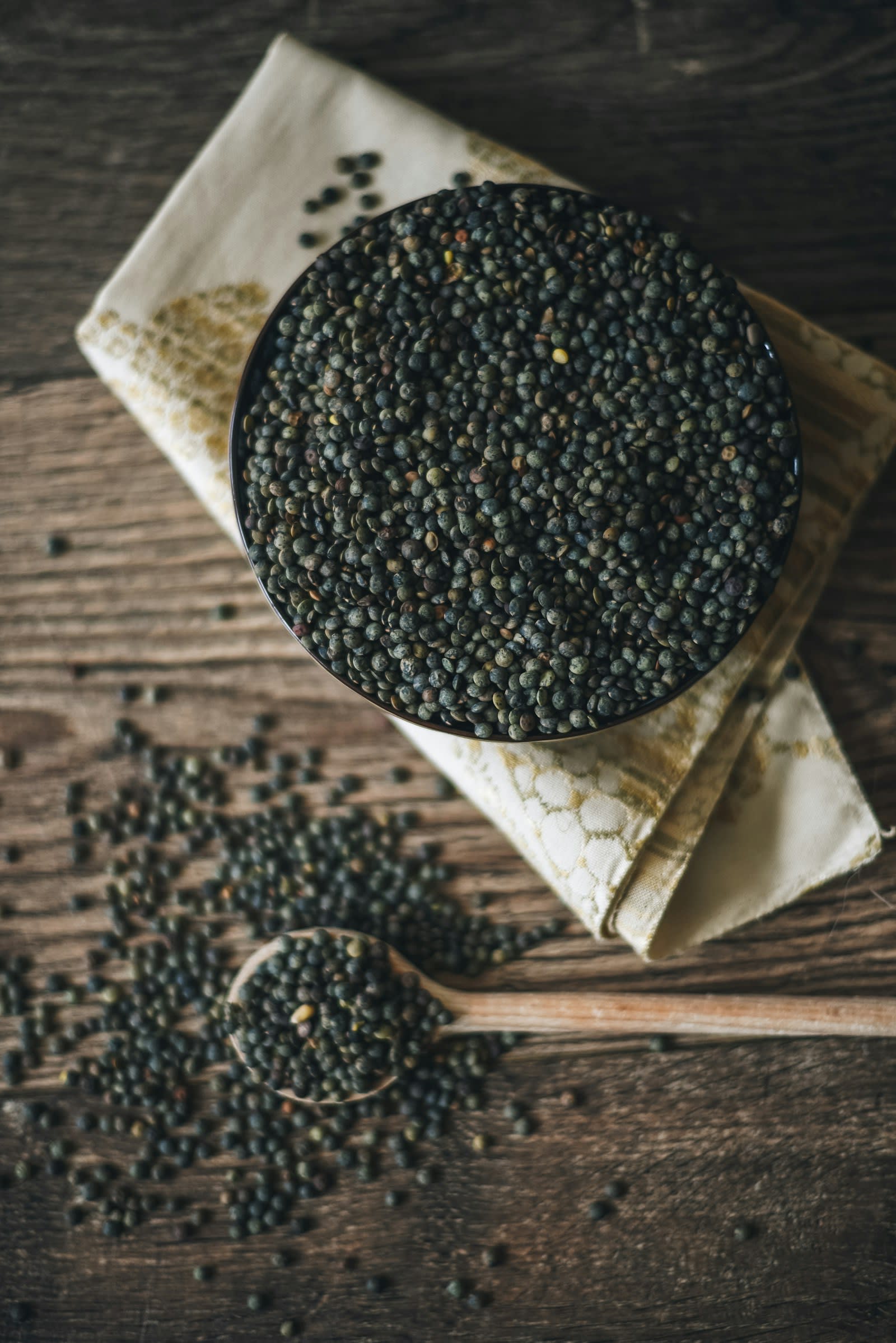
| Lentils, cooked | 1 cup (198 g) | 15 g |
| Black beans, cooked | 1/2 cup (86 g) | 7 to 8 g |
| Chickpeas, cooked | 1/2 cup (82 g) | 6 g |
| Raspberries | 1 cup (123 g) | 8 g |
| Pear, with skin | 1 medium | 5 to 6 g |
| Apple, with skin | 1 medium | 4 to 5 g |
| Avocado | Half | 5 g |
| Broccoli, cooked | 1 cup | 5 g |
| Whole-wheat spaghetti, cooked | 1 cup | 6 g |
| Potato, baked with skin | 1 medium | 4 g |
| Oatmeal, cooked | 1 cup | 4 g |
| Chia seeds | 1 tablespoon | 4 g |
| Almonds | 28 g (1 oz) | 3.5 g |
| Popcorn, air-popped | 3 cups | 3.5 g |
| Whole-wheat bread | 1 slice | 2 to 3 g |
| White bread | 1 slice | under 1 g |
To see how it adds up, a cup of oatmeal with half a cup of raspberries and a spoonful of chia seeds gives about 12 g. A whole-wheat sandwich and an apple at lunch adds around 9 g. A chickpea curry with a cup of broccoli at dinner brings another 11 g. That day lands just over 30 g, with no supplements and nothing unusual on the plate.
How can you increase your fiber intake without side effects?
Going from 15 g to 35 g overnight is the classic mistake. Your gut bacteria need time to adjust, and a sudden jump often means a few uncomfortable days. A gradual approach works better:
- Note roughly what you eat now. If you are around 15 g, your first goal is 20 g, not 30.
- Add one higher-fiber food every few days, such as swapping white bread for whole-wheat or adding beans to a soup.
- Spread fiber across the day instead of loading it into one meal.
- Keep the skins on potatoes, apples and pears where you can.
- Drink enough fluid. The NHS suggests 6 to 8 glasses a day, and more in hot weather or when you exercise.
- Give it two to three weeks at each step before adding more.
Water matters more than people expect. Fiber, especially insoluble fiber and bulking supplements like psyllium, pulls water into the bowel. Without enough fluid, more fiber can make constipation worse instead of better. Fiber supplements should always be taken with a full glass of water.
Why does fiber make you bloated?
Bacteria in your large intestine ferment some types of fiber, and that process produces gas. Beans, lentils, onions, cabbage, broccoli and some whole grains are common culprits. A bit more gas is normal and usually means the bacteria are doing their job.
For most people, bloating and wind settle within a few weeks as the gut adapts. Soaking and rinsing dried beans, or rinsing canned ones, can help. So can starting with smaller portions and building up.
Is fiber good or bad for IBS?
It depends on the type. For people with irritable bowel syndrome, soluble fiber, such as oats or psyllium, often helps both constipation and diarrhea. Insoluble fiber, especially wheat bran, can make bloating and pain worse for some people. The NHS suggests that people with IBS try oats and up to a tablespoon of linseeds a day, and cut back on high-fiber foods like bran if they trigger symptoms.
There is a catch. Many high-fiber foods, including beans, onions, garlic, apples and pears, are also high in fermentable carbohydrates known as FODMAPs, which commonly trigger IBS symptoms. A low-FODMAP diet can help, but it is restrictive and best done with a dietitian, and only for a few weeks before foods are slowly reintroduced. Cutting fiber across the board usually backfires.
When should you see a doctor?
See a doctor promptly if you have any of the following, whatever your fiber intake:
- Blood in your stool, or black, tarry stools
- A change in bowel habits that lasts more than three weeks
- Unexplained weight loss or extreme tiredness
- Severe belly pain, vomiting, or being unable to pass gas or stool
- A lump or ongoing pain in your abdomen
Check with a doctor or dietitian before raising your fiber intake a lot if you have Crohn's disease, a narrowing of the bowel, gastroparesis or past bowel surgery, or if you are recovering from a flare of diverticulitis. People with kidney disease may need to watch potassium and phosphorus in beans, nuts and some fruits. If you take medicine, ask a pharmacist about fiber supplements, because they can reduce the absorption of some drugs and are usually taken a couple of hours apart from them.
Frequently asked questions
Do fiber supplements work as well as food?
Some do part of the job. Psyllium, for example, can lower LDL cholesterol and ease constipation. Food still wins, because whole grains, beans, fruit and vegetables bring many types of fiber along with vitamins, minerals and plant compounds a powder does not.
Is fruit juice a good source of fiber?
No. Juicing removes most of the fiber and leaves the sugar. Whole fruit is the better choice, and smoothies keep the fiber but make it easy to drink a lot of fruit sugar quickly.
Can you eat too much fiber?
There is no official upper limit. Very high intakes, well above 50 g a day, mostly cause gas, bloating and loose stools, and may slightly reduce how well some minerals are absorbed. Problems are more likely when fluid intake is low.
Does cooking destroy fiber?
Not much. Cooking softens fiber and can make vegetables easier to digest, but the fiber content stays similar. Peeling has a bigger effect, since much of the fiber in potatoes, apples and carrots sits in or just under the skin.
References
- Fiber, Harvard T.H. Chan School of Public Health
- How to get more fibre into your diet, NHS
- Soluble vs. insoluble fiber, MedlinePlus
- Eating, Diet, & Nutrition for Irritable Bowel Syndrome, NIDDK
- Irritable bowel syndrome (IBS), NHS
This article is general information, not medical advice. Check with a doctor before changing your diet, exercise or supplements. Read our medical disclaimer.

Comments
No comments yet. Questions and experiences are welcome.
Leave a comment
Your email is never published. Comments appear after a quick moderation check.